
White Papers
Our white papers explore emerging ideas, research-informed frameworks, and system-level challenges in education. These documents examine complex learning and organizational issues while offering thoughtful perspectives on how schools and learning systems can respond.
Each white paper combines research insights, practical experience, and systems thinking to help leaders and educators better understand the forces shaping modern learning environments.
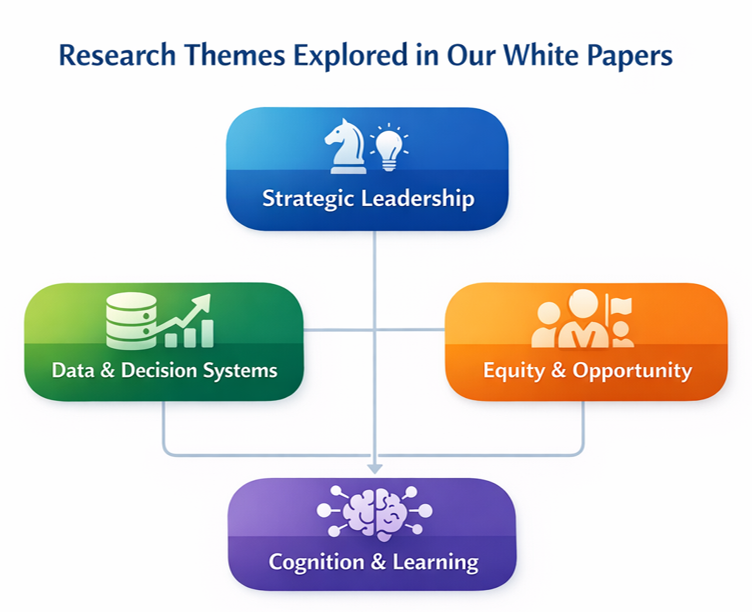
Research Themes
Our white papers explore several interconnected themes related to learning systems, leadership, and cognitive development.
Key Questions Explored in Our White Papers
Our white papers examine complex questions facing modern learning systems and educational organizations. The following themes reflect the types of questions explored throughout this work.
Strategic Leadership
How can educational leaders design long-term strategies that remain resilient in the face of financial, policy, and organizational uncertainty?
Data and Decision Making
What structures help schools move from collecting large amounts of data to making meaningful instructional and strategic decisions?
Equity and Opportunity
What long-term systems influence achievement gaps, and how can districts create environments that expand opportunity for all students?
Cognition and Learning
How does reasoning develop, and how can learning environments better support deep thinking and cognitive growth?
Topics include strategic planning in education, data-informed decision making, cognitive development, school district leadership, and long-term system improvement.
White Papers
Strategic Resilience: Financial Contingency Planning for K–12 School Districts
This white paper explores how school districts can strengthen long-term stability through strategic financial planning. It examines contingency planning models, fiscal risk management, and leadership approaches that help districts navigate economic uncertainty while maintaining instructional priorities.
Read the Strategic Resilience Financial Planning White Paper →
Holistic Stakeholder-Driven Strategic Planning in Education
This paper examines how strategic planning processes in education can move beyond compliance-driven plans to become collaborative systems for improvement. It highlights stakeholder engagement, systems alignment, and decision-making structures that help districts translate strategic vision into sustained action.
Read the Stakeholder-Driven Strategic Planning White Paper →
Closing Achievement Gaps and Achieving College & Career Readiness
This analysis examines long-term patterns related to achievement gaps and postsecondary readiness. The paper explores systemic factors influencing student outcomes and discusses strategies districts can consider when working to strengthen equitable access to college and career opportunities.
Read the Achievement Gaps and College Career Readiness Analysis →
Strategic Data Use in K–12 Schools: Turning Numbers into Actionable Insights
This white paper explores how districts can move beyond data collection toward meaningful interpretation and decision-making. It discusses how leadership teams and educators can transform large volumes of educational data into insights that support instructional improvement and system-level learning.
The COGIT Framework: Understanding Cognitive Development and Reasoning Systems
This white paper introduces the COGIT framework, a model for understanding how reasoning develops and how learning environments can support cognitive growth. It outlines key concepts within the framework and explores implications for instruction, system design, and future research.
White Paper Abstracts
Strategic Resilience: Financial Contingency Planning for K–12 School Districts
School districts operate within increasingly complex financial environments where economic shifts, policy changes, and enrollment fluctuations can rapidly affect long-term stability. This white paper examines strategic approaches to financial contingency planning in K–12 education, exploring how district leaders can build resilient budgeting models while maintaining instructional priorities. The paper discusses risk management, scenario planning, and leadership strategies that help districts sustain programs and services during periods of financial uncertainty.
Holistic Stakeholder-Driven Strategic Planning in Education
Strategic planning is often treated as a compliance exercise rather than a living framework for organizational improvement. This white paper explores how stakeholder-driven planning models can strengthen alignment across district leadership, educators, and community members. The paper examines collaborative planning structures, decision-making frameworks, and implementation practices that help educational organizations translate long-term vision into sustained action.
Closing Achievement Gaps and Achieving College & Career Readiness
Closing achievement gaps and improving college and career readiness remain central priorities for many school systems. This analysis examines long-term patterns related to student performance, opportunity gaps, and readiness outcomes. The paper discusses systemic factors influencing achievement and explores strategies districts can consider when building environments that support equitable access to academic success and postsecondary pathways.
Strategic Data Use in K–12 Schools
School systems generate large amounts of data, yet translating those numbers into meaningful instructional decisions remains a persistent challenge. This white paper explores how districts can strengthen data-informed decision-making by focusing on interpretation rather than collection. The paper examines leadership structures, data literacy practices, and system design approaches that help educators transform data into actionable insights that support learning improvement.
The COGIT Framework
The COGIT framework offers a model for understanding how reasoning develops and how learning environments can better support cognitive growth. This white paper introduces the theoretical foundations of the framework and explores its implications for instruction, learning design, and educational systems. The paper also discusses how cognition-focused models may help educators move beyond surface-level performance measures toward deeper understanding of student thinking.
Copyright © 2026 · All Rights Reserved · Limitless Learning Solutions