COGIT™ Framework
Improving learning systems requires more than new programs or additional data. It requires understanding how educators and learners reason through complex problems and how those patterns influence instructional decisions.
The COGIT™ Framework is designed to help educators and organizations examine these reasoning patterns, identify barriers to effective learning, and strengthen the systems that support instructional improvement.
Rather than focusing on isolated interventions, the framework focuses on the underlying processes that shape how learning unfolds within classrooms and organizations.
To understand how this work connects to real-world implementation, explore our learning solutions for schools or see it in action through our case studies.
The COGIT Framework
What is the COGIT™ Framework?
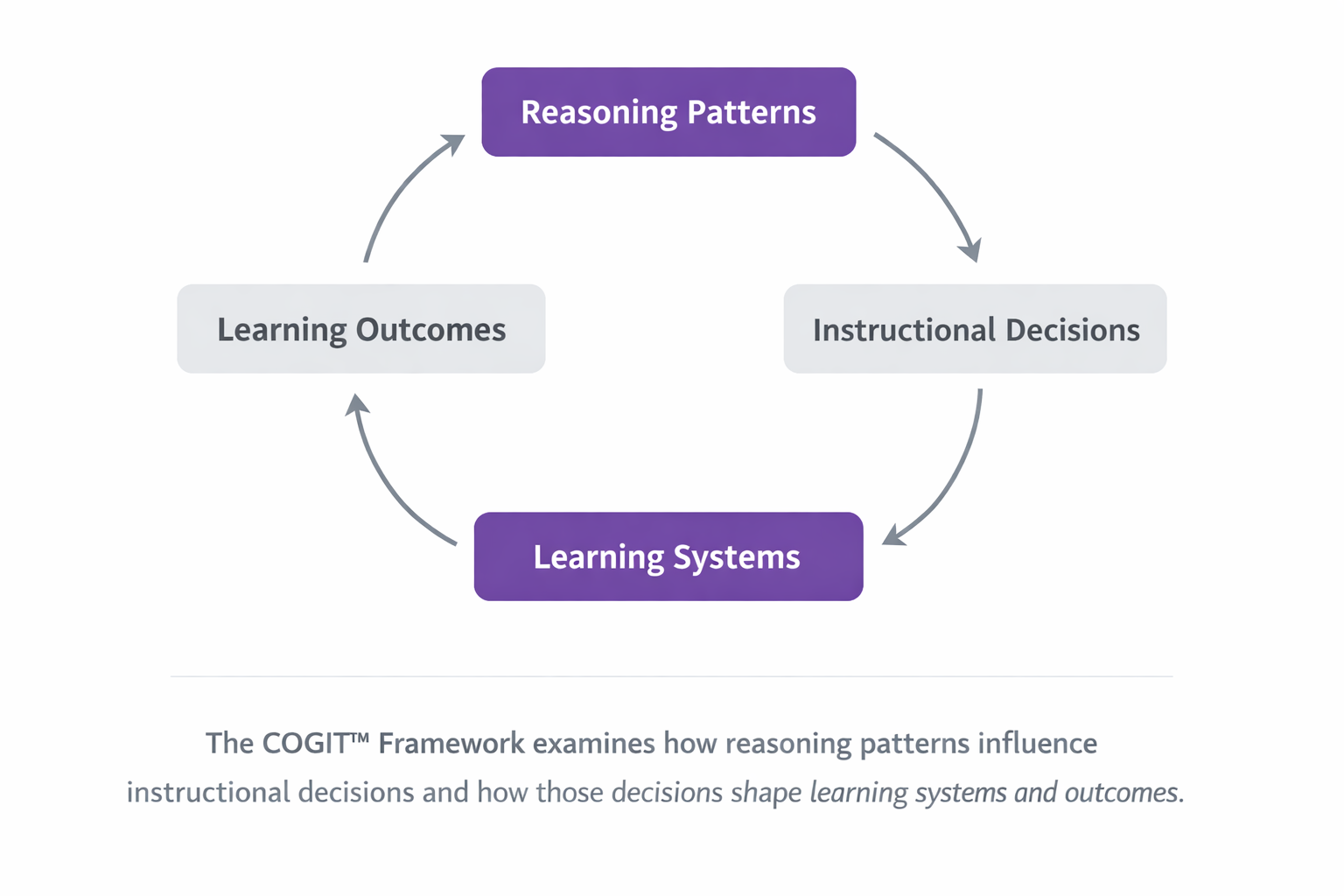
The COGIT™ Framework is a research-informed approach to examining how reasoning, instructional decisions, and system structures interact within learning environments.
At its core, the framework seeks to answer a simple but important question:
How do people reason when they encounter complex learning challenges?
Understanding these reasoning patterns allows educators and leaders to better identify where learning barriers emerge and how instructional systems can be improved to support deeper understanding.
The COGIT™ Framework examines how reasoning patterns influence instructional decisions and how those decisions shape learning systems and outcomes.
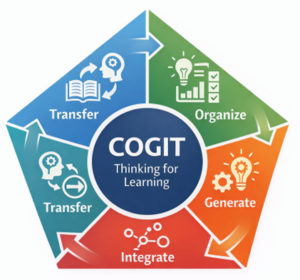
The COGIT™ Framework is a structured system for developing reasoning. It combines cognitive structuring tools, activation strategies, and developmental progressions to make thinking visible, teachable, and transferable across contexts.
These ideas are applied in practice through projects like Operation Mind’s Eye, where reasoning and decision-making are made visible in real learning environments.
The A–B–C Model of Learning
Most learning systems focus on instruction and content. They assume that strong teaching automatically produces strong thinking. In reality, an essential transformation step is often invisible.
COGIT makes this hidden process explicit through the A–B–C Model.
A — Instruction and Content
The lessons, texts, data, and experiences learners encounter.
B — Cognitive Structuring Tools and Activation Strategies
The transformation layer where learners organize information, frame problems, reason through relationships, and apply thinking strategies.
C — Transferable Outcomes
The durable results of learning: coherent reasoning, problem solving, and adaptive decision-making across new situations.
By making the “B layer” explicit, COGIT ensures that learning consistently leads to transferable thinking.
The Architecture of Thinking
COGIT organizes cognitive development across two dimensions: a vertical progression of growth and a set of cross-cutting thinking moves.
Developmental Domains describe how reasoning expands over time, from foundational structuring to resilient cognition.
Thinking Pillars represent the core moves of thinking that operate across every domain:
• Filtering — identifying what matters
• Framing — defining how a problem is understood
• Reasoning — connecting causes and consequences
• Integration — synthesizing ideas into coherent insight
• Optimization — refining decisions and solutions
Together, the Domains and Pillars create a map of how thinking develops and how reasoning skills transfer across contexts.
Why Cognitive Integrity Matters
In an era of artificial intelligence, deepfakes, and information overload, the ability to reason clearly has become essential.
Learners must be able to filter overwhelming information, frame complex problems, evaluate competing claims, and make decisions under uncertainty.
COGIT provides a practical framework for developing these capabilities by turning the hidden processes of thinking into explicit tools that learners can practice and apply across subjects and real-world situations.
Why Reasoning Matters in Education Systems
Many improvement efforts focus on curriculum, assessments, or professional development. While these elements matter, they often operate within systems where educators and leaders must constantly interpret information, make judgments, and respond to complexity.
When the reasoning patterns within a system remain invisible, even strong initiatives can produce inconsistent results.
The COGIT™ Framework helps make these patterns visible so that educators and leaders can better understand how learning challenges emerge, how decisions are shaped, and how instructional systems can respond more effectively.
Connecting Research and Practice
The framework draws on insights from learning science, cognitive research, and systems thinking. It is designed to operate within real educational environments rather than controlled laboratory conditions.
Through research partnerships and design-based research methods, the framework continues to evolve as new insights emerge from practice.
This approach allows research and implementation to inform one another, strengthening both the theoretical understanding of learning systems and the practical tools used by educators.
From Framework to Tools
Frameworks become most valuable when they support real-world practice.
The COGIT™ Framework informs the development of tools and platforms designed to help educators and leaders examine reasoning patterns, analyze learning data, and strengthen instructional decision-making.
One such platform is COGIT Lab, which explores how technology can support these efforts in practical educational settings.
Explore the COGIT™ Framework
The pages below explore the conceptual foundations, scientific research, and applied tools that make up the COGIT™ Framework. Together they explain how the framework examines reasoning patterns and supports improvement in learning systems.
What is COGIT™
An introduction to the COGIT™ Framework and the core idea that understanding reasoning patterns is essential to improving learning systems.
The Science Behind COGIT™
Explore the learning science, cognitive research, and systems thinking that inform the development of the COGIT™ Framework.
COGIT™ in STEM Learning
See how the framework is applied within STEM learning environments to examine reasoning patterns and strengthen instructional decision-making.
COGIT Lab
Learn about the technology platform being developed to support analysis of reasoning patterns and learning processes in real-world educational environments.
COGIT™ White Paper
Read a deeper explanation of the framework’s conceptual foundations, research questions, and long-term research agenda.
Research & Pilot Studies
Explore ongoing and planned research partnerships examining how the COGIT™ Framework functions within real educational systems.
From Framework to Practice
Frameworks become most valuable when they support real-world improvement.
The following solutions explore how these ideas can be implemented in practice.
Interested in collaborating?
Limitless Learning Solutions works with districts, universities, and organizations exploring how learning systems can be improved through research, system design, and practical implementation.
Explore Collaboration Opportunities
Interested in learning how the COGIT™ Framework could support your district, organization, or research initiative?
Limitless Learning Solutions collaborates with educators, researchers, and leaders to explore practical applications
of cognitive development and reasoning systems.
COGIT™ Research Program Areas
The development of the COGIT™ Framework is supported by an evolving research program that explores reasoning development, learning system design, and instructional applications across multiple domains.
For a deeper look at the theoretical foundations, explore the science behind COGIT™ or review the full COGIT™ white paper.
Reasoning Development
Investigating how reasoning processes develop and how they can be strengthened through structured cognitive tools.
Learning Systems
Exploring how instructional systems shape the ways educators interpret information and make instructional decisions.
STEM Learning
Examining how reasoning tools can support problem solving and complex thinking in STEM learning environments.
Measurement & Analytics
Developing approaches to capture patterns in reasoning and generate insights that inform learning system improvement.
COGIT™ is a trademark of Limitless Learning Solutions LLC.
Copyright © 2026 · All Rights Reserved · Limitless Learning Solutions