
COGIT™ in STEM Learning
STEM learning asks students to do more than remember information. It asks them to investigate problems, interpret evidence, test ideas, make decisions, and apply knowledge in new situations. COGIT™ supports this work by making the underlying processes of reasoning more visible, teachable, and transferable.
By helping learners filter information, frame problems, reason through relationships, integrate ideas, and optimize solutions, the COGIT™ Framework provides a practical structure for supporting deeper thinking in STEM classrooms and related learning environments.
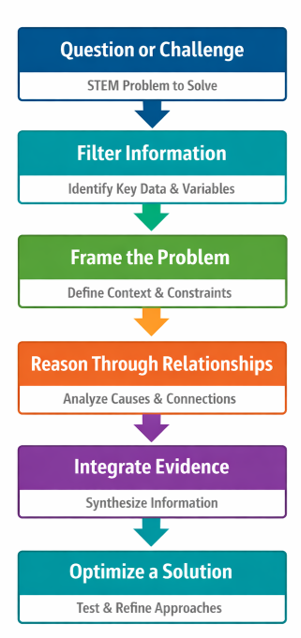
Figure: Reasoning in STEM Problem Solving
COGIT™ organizes complex problem solving into a sequence of cognitive moves—filtering information, framing problems, reasoning through relationships, integrating evidence, and optimizing solutions. These thinking processes support deeper learning across scientific inquiry, mathematical reasoning, and engineering design.
Why STEM Is a Natural Fit for COGIT™
STEM learning naturally places students in situations where reasoning matters. Learners must distinguish relevant from irrelevant information, identify patterns, test assumptions, weigh constraints, and revise their thinking as new evidence emerges.
These demands align closely with the core goals of COGIT™. Rather than treating reasoning as an invisible byproduct of instruction, the framework helps make these cognitive moves explicit so they can be modeled, practiced, and strengthened over time.
COGIT™ in STEM Learning
STEM learning asks students to do more than remember information. It asks them to investigate problems, interpret evidence, test ideas, make decisions, and apply knowledge in new situations. COGIT™ supports this work by making the underlying processes of reasoning more visible, teachable, and transferable.
By helping learners filter information, frame problems, reason through relationships, integrate ideas, and optimize solutions, the COGIT™ Framework provides a practical structure for supporting deeper thinking in STEM classrooms and related learning environments.
Why STEM Is a Natural Fit for COGIT™
STEM learning naturally places students in situations where reasoning matters. Learners must distinguish relevant from irrelevant information, identify patterns, test assumptions, weigh constraints, and revise their thinking as new evidence emerges.
These demands align closely with the core goals of COGIT™. Rather than treating reasoning as an invisible byproduct of instruction, the framework helps make these cognitive moves explicit so they can be modeled, practiced, and strengthened over time.
How COGIT™ Supports STEM Thinking
COGIT™ organizes reasoning into five core thinking moves that are especially important in STEM learning:
- Filtering — identifying the most relevant information, variables, or evidence
- Framing — defining the problem, context, or system being examined
- Reasoning — connecting causes, relationships, and implications
- Integration — bringing multiple ideas, observations, or representations into coherent understanding
- Optimization — refining approaches, testing alternatives, and improving solutions under constraints
In STEM settings, these moves can support everything from scientific inquiry and mathematical problem solving to engineering design and data interpretation. The framework helps ensure that students are not just completing tasks, but developing the habits of mind needed to think more clearly and apply learning across contexts.
What COGIT™ Can Look Like in Practice
In a STEM classroom, COGIT™ can be embedded into instruction through questioning routines, collaborative tasks, design challenges, data analysis activities, and structured problem-solving experiences.
For example, students might use filtering strategies to identify relevant variables in an experiment, framing strategies to define the boundaries of an engineering problem, reasoning strategies to explain relationships in a system, integration strategies to connect multiple data sources, and optimization strategies to improve a proposed solution.
These supports help shift STEM instruction from simply covering content toward deliberately building the reasoning processes that make deeper learning possible.
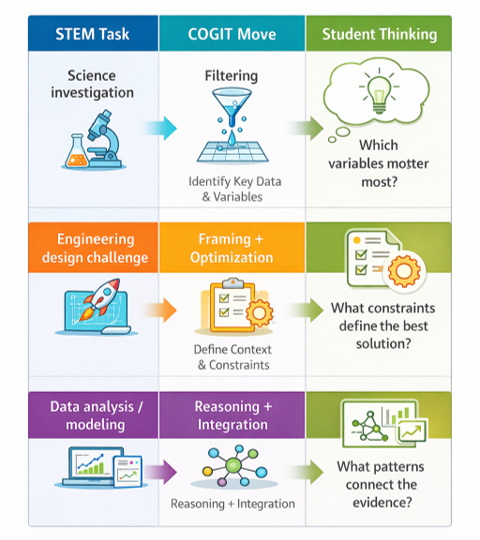
Figure: Examples of COGIT™ Reasoning Moves in STEM Learning
COGIT™ connects common STEM tasks—such as scientific investigation, engineering design, and data analysis—with specific reasoning processes. By making these thinking moves explicit, educators can help students focus on the cognitive strategies that support deeper understanding and more effective problem solving.
Why Transfer Matters in STEM
One of the greatest challenges in education is helping learners transfer their thinking to new situations. Students may succeed with familiar tasks but struggle when a problem changes context, introduces new variables, or requires them to apply reasoning in an unfamiliar way.
COGIT™ is designed to address that challenge by helping learners recognize underlying reasoning patterns and carry them across tasks, disciplines, and real-world situations. In STEM learning, this means students are better prepared not only to solve the problem in front of them, but to adapt their thinking when the next challenge looks different.
Supporting Learners and Systems
COGIT™ can support STEM learning at multiple levels. In classrooms, it helps teachers make reasoning visible during instruction. In professional learning, it gives educators a shared language for discussing cognitive development. At the district level, it can help align curriculum, assessment, and instructional improvement around the development of reasoning rather than content alone.
This makes COGIT™ especially valuable for schools and organizations seeking to strengthen STEM learning in ways that are research-informed, practical, and scalable.
Explore the COGIT™ Framework
Learn more about the framework, its research foundations, technology platform, and ongoing development.
What is COGIT™
Learn how the COGIT™ framework helps make reasoning visible, teachable, and transferable across learning environments.
The Science Behind COGIT™
Explore the cognitive science, learning theory, and research foundations that inform the framework.
COGIT Lab
Learn about the technology platform being developed to support implementation, measurement, and cognitive growth.
Research & Pilot Studies
Review how COGIT™ is being studied, refined, and prepared for validation through research partnerships and pilot implementations.
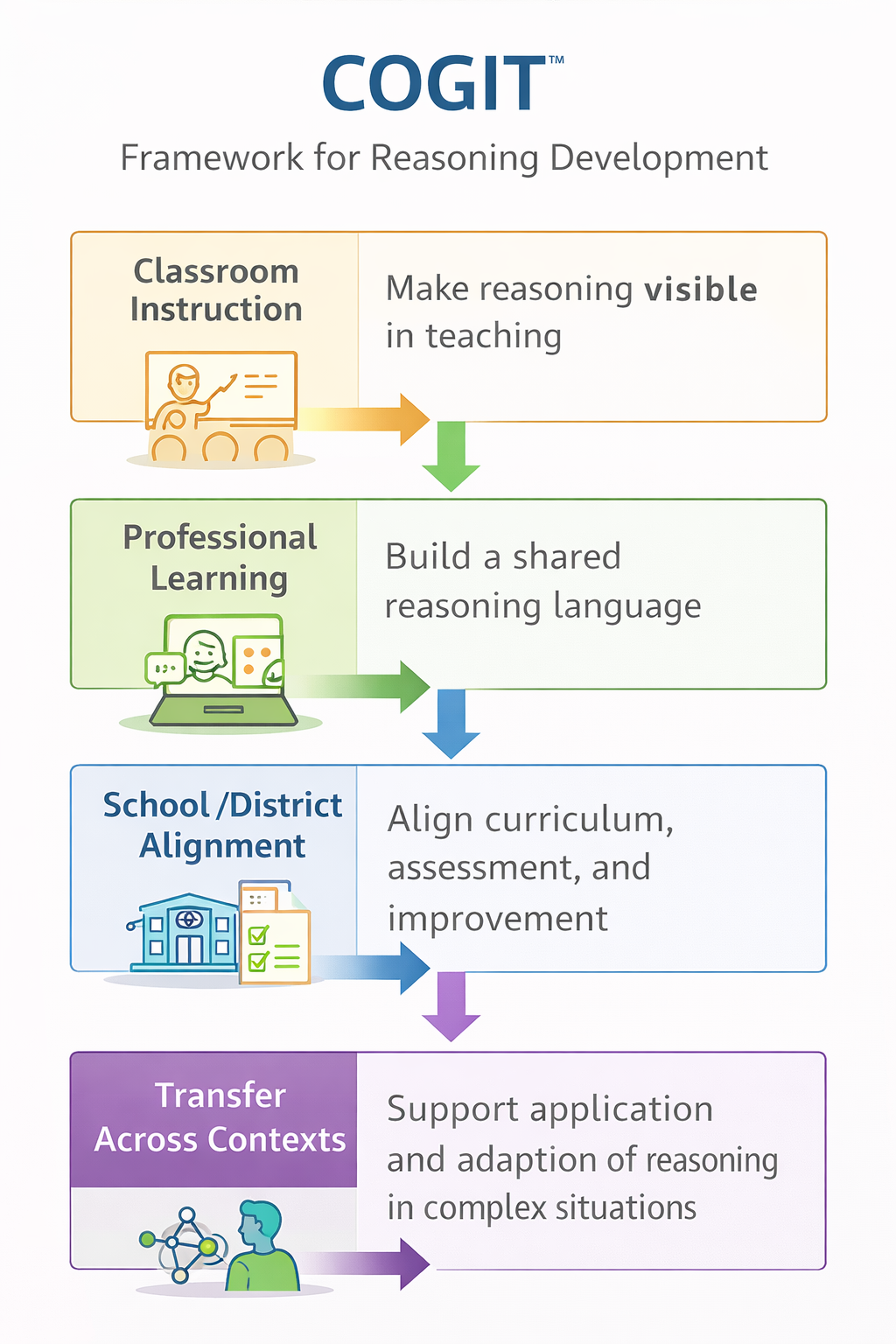
Figure: Scaling Reasoning Development Across Learning Systems
The COGIT™ Framework supports reasoning development at multiple levels of a learning system. In classrooms, it helps make thinking visible during instruction. Through professional learning, it builds a shared language for reasoning among educators. At the school and district level, it can support alignment of curriculum, assessment, and improvement efforts while helping learners transfer their thinking across new contexts.
Explore Collaboration Opportunities
Interested in learning how the COGIT™ Framework could support your district, organization, or research initiative?
Limitless Learning Solutions collaborates with educators, researchers, and leaders to explore practical applications
of cognitive development and reasoning systems.
COGIT™ is a trademark of Limitless Learning Solutions LLC.
Copyright © 2026 · All Rights Reserved · Limitless Learning Solutions