
Leadership Capacity
District and school leaders are often expected to carry an extraordinary range of responsibilities at once. They are asked to guide instruction, respond to operational demands, support staff, manage compliance, interpret data, communicate with stakeholders, and sustain improvement efforts across complex systems.
In many cases, the challenge is not a lack of leadership commitment or expertise. The challenge is capacity. When the number of demands placed on leaders exceeds the structures available to support the work, even strong leaders can struggle to maintain coherence, focus, and momentum over time.
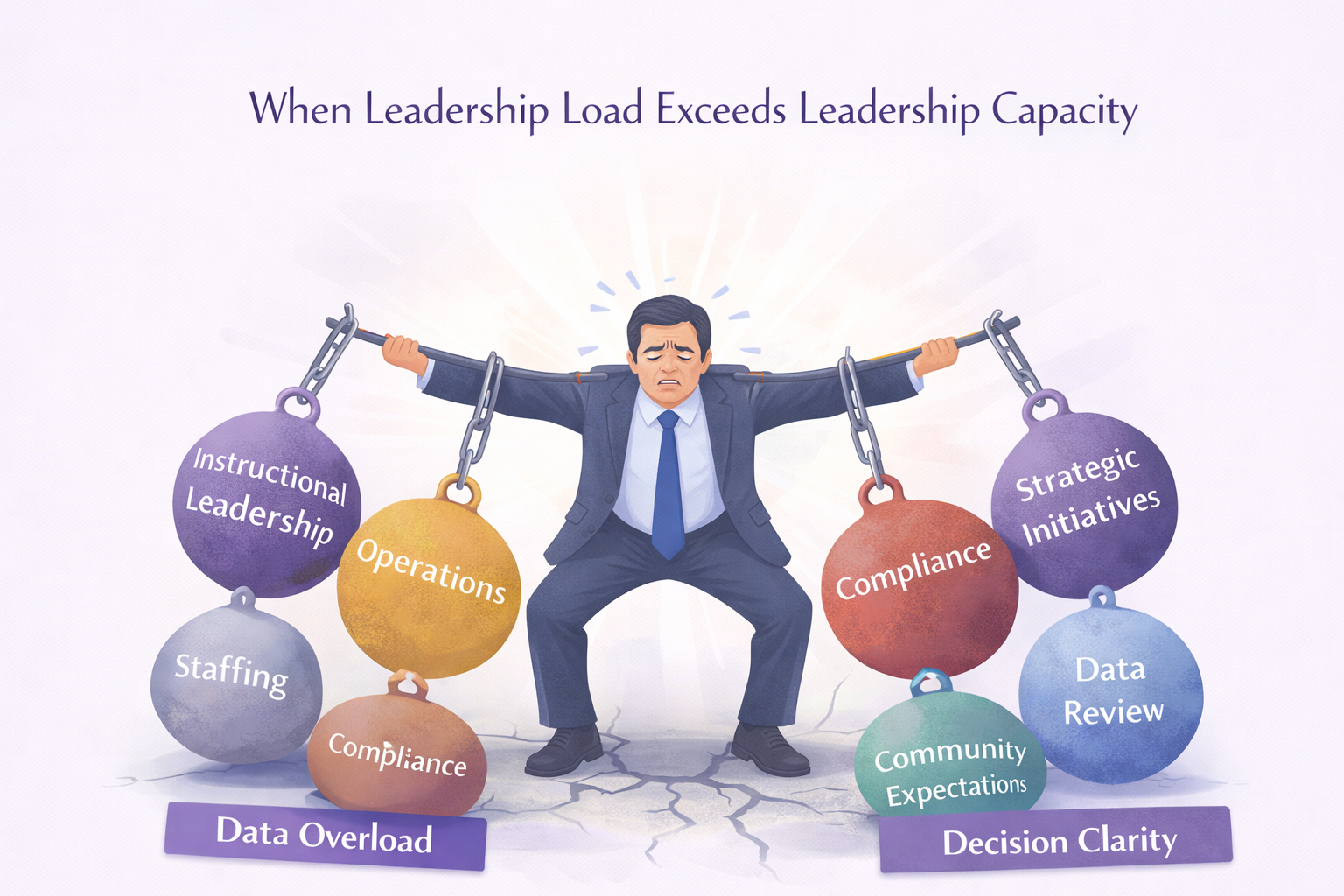
Leadership effectiveness depends not only on individual skill, but on the system conditions that shape what leaders can realistically sustain.
What the Challenge Looks Like
Leadership capacity challenges often appear as fragmentation rather than obvious breakdown. Priorities compete for attention, leaders shift constantly between urgent and important tasks, and improvement efforts can lose traction as operational demands accumulate.
In districts and schools, this may look like leaders trying to support too many initiatives at once, limited time for instructional leadership, uneven follow-through on strategic priorities, or difficulty creating the sustained attention that meaningful implementation requires. These are not simply personal productivity issues. They are often structural conditions within the system itself.
Why It Matters
When leadership capacity is overstretched, even well-designed initiatives become harder to implement. Teams may receive mixed signals, support structures may weaken, and the district’s ability to monitor progress or refine strategy can diminish.
This matters because improvement depends on more than strong plans. It depends on the people responsible for carrying those plans forward having sufficient clarity, support, and bandwidth to lead effectively over time.
What Strengthens Leadership Capacity
Clear Prioritization
Leaders are better able to sustain momentum when systems reduce initiative overload and create clearer focus around the most important work.
Role Clarity
Capacity improves when responsibilities are defined more clearly and leadership work is distributed intentionally across the system.
Supportive Structures
Strong systems provide routines, tools, and processes that reduce unnecessary burden and help leaders stay connected to improvement work.
Meaningful Feedback
Leaders need usable evidence and manageable feedback systems that help them monitor implementation and make informed adjustments.
From Strain to Sustainable Leadership
Improving leadership capacity is not simply about asking leaders to do more efficiently. It involves designing systems that are more coherent, more focused, and better aligned to the realities of leadership work.
When districts create stronger conditions for leadership, they increase the likelihood that strategic priorities will remain visible, implementation will remain supported, and improvement efforts will be sustained over time.
Work With Us
We work with districts and organizations seeking stronger systems for leadership, implementation, and sustained improvement.
Next Challenge: Equity Implementation →
Copyright © 2026 · All Rights Reserved · Limitless Learning Solutions