Strategic Planning in Districts
Strategic planning is often intended to bring focus, coherence, and direction to district improvement efforts. At its best, it helps leaders align goals, resources, initiatives, and decision-making around a shared vision for student learning and organizational growth.
In practice, however, many districts experience a gap between strategic intent and day-to-day implementation. Plans may be well written, but priorities can become diluted as they move through departments, campuses, programs, and competing initiatives. Over time, the challenge becomes not simply creating a plan, but ensuring that the plan remains visible, actionable, and connected to real work.
When Strategy Fragments
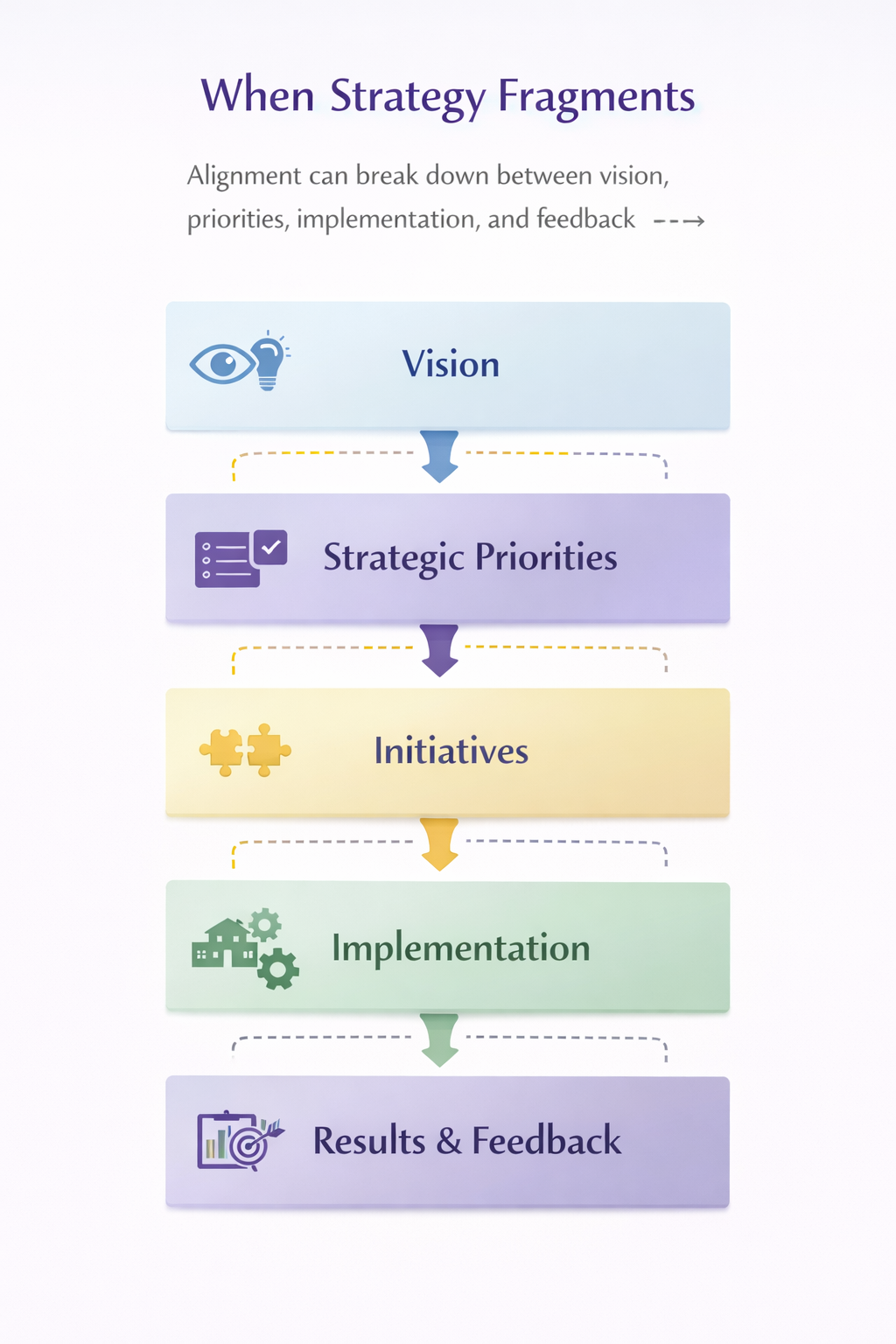
Strong strategic plans can lose power when alignment breaks down between vision, priorities, implementation, and feedback.
Vision
A district may begin with a clear direction and a strong statement of purpose for where it wants to go.
Priorities
Strategic priorities are established, but they may compete with existing demands, legacy initiatives, or unclear ownership.
Initiatives
Programs and action steps emerge, but not all remain tightly connected to the original strategy or to one another.
Implementation
Schools and teams translate the work into practice, often under varying conditions, capacities, and interpretations.
Results & Feedback
Evidence is collected, but it is not always structured in a way that helps leaders see whether the strategy is truly driving improvement.
What the Challenge Looks Like
In many districts, strategic planning challenges do not appear as a lack of effort. They appear as fragmentation. Teams may be working hard, schools may be implementing multiple initiatives, and leaders may be deeply committed to improvement, yet the work can still feel diffuse.
Common signs include too many priorities moving at once, uneven understanding across departments or campuses, limited visibility into implementation quality, and difficulty knowing whether activities are producing the intended outcomes. In these situations, a district may have a strategy on paper without yet having full strategic coherence in practice.
Why It Matters
When planning and implementation are weakly connected, improvement efforts become harder to sustain. Resources can be spread too thin, staff may experience initiative fatigue, and leaders may struggle to distinguish between activity and actual progress.
This matters not only for execution, but also for learning. A district cannot refine strategy effectively if it lacks clear ways to see what is being implemented, what is changing, and where stronger alignment is needed. Strategic planning becomes most powerful when it supports both direction and disciplined feedback.
How Stronger Systems Address the Problem
Stronger strategic planning systems do more than define goals. They create clearer alignment between vision, priorities, action, and evidence. That may include stronger initiative mapping, better role clarity, more coherent implementation supports, and measurement structures that help leaders monitor progress in meaningful ways.
From a research-informed perspective, strategic planning becomes more effective when it is treated as an ongoing system of design, implementation, and refinement rather than a one-time planning event. Districts need not only plans, but processes that help strategy remain visible, actionable, and learnable over time.
From Planning to Coherence
At Limitless Learning Solutions, we view strategic planning as part of a broader challenge of system coherence. The goal is not simply to create a stronger document, but to help build conditions where priorities remain connected to implementation, and where evidence can support stronger future decisions.
Work With Us
We support districts and organizations seeking more coherent, research-informed approaches to planning, implementation, and continuous improvement.
Schedule a Conversation |
Explore Strategic Planning Solutions
Next Challenge: PLC Effectiveness →
Copyright © 2026 · All Rights Reserved · Limitless Learning Solutions